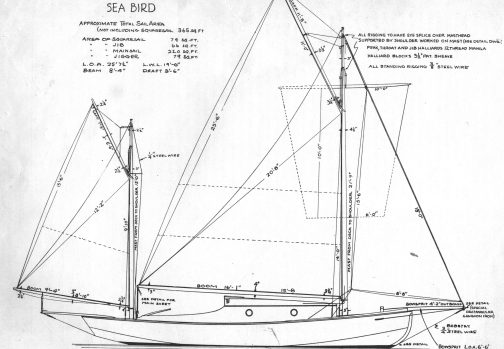
This is the story of a little wooden boat we found in a barnyard a long time ago and the continuing adventure she’s taken us on. The boat is a gaff-rigged yawl named Irene Agnes. No, we did not give her that name, but we could never change it. “Aggie”, as we affectionately call her, is a Sea Bird yawl – a design that dates back to 1901. Aggie herself dates back at least to the 1930s, and probably earlier.
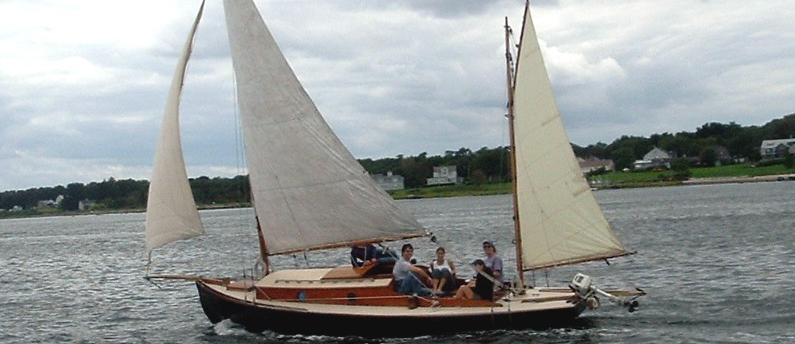
If you’ve found this blog, you might already have some idea what a Sea Bird is, but when I stumbled on Aggie in an online ad in 2004, I’d only vaguely heard of the Sea Bird yawl. Laurie and I were living in Rhode Island, and I was just looking for a boat to play with on Narragansett Bay. Aggie ended up being an amazing boat to sail but also connected me to an incredibly rich history that has changed my life in more ways than I could have imagined.
The Sea Bird
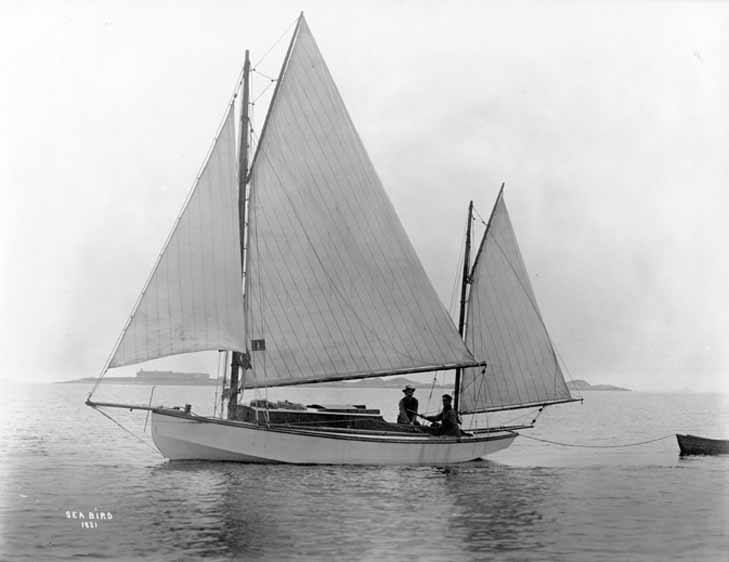
The Sea Bird yawl was conceived in 1901 by Thomas Fleming Day, editor of The Rudder, America’s first recreational sailing and boating magazine, which Day founded in 1890. The plans were drawn by Charles Mower, the magazine’s design editor, and the construction drawings were created by Larry Huntington, a New York boatbuilder who built the first hull, named Sea Bird. They published the design in the magazine, sold plans, and, later, a detailed “how-to-build” book.
In a gilded age when yachting was dominated by wealthy industrialists with professional crews, Tom Day believed that middle-class people could and should go out and have adventures on small boats that they sailed themselves. The Sea Bird was designed to meet that need in a simple boat that was relatively easy to build yet capable of seagoing voyages. To prove it, Day took Sea Bird on dramatic voyages, recounting the details of the boat’s performance in The Rudder. In 1910, he and two other crew sailed Sea Bird across the Atlantic from Rhode Island to Italy.
Sea Bird‘s exploits helped make the design hugely successful, but because Day never controlled who built the boat or how, he and Mower never really made money off it in the way that most yacht designers did. No one knows how many Sea Birds have been built in the last 124 years, but it became an iconic design synonymous with the democratization of yachting.
Irene Agnes Finds Us
Irene Agnes is certainly part of that story. Originally built in Grosse Point, Michigan, the keel may have been laid in 1914, but it is not clear that she ever got underway until about 1933. A previous owner managed to track down titles and registrations for the boat going back nearly that far. Aggie’s long story from Michigan to Massachusetts includes detours through Maine and Maryland and is fodder for another post.
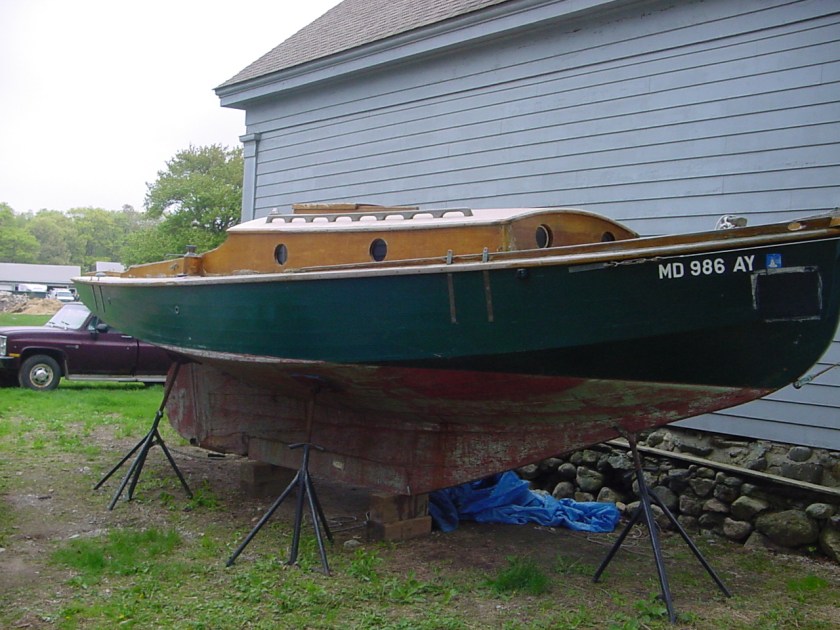
We found her in a barnyard in Scituate, Massachusetts in 2004, but the coincidences surrounding that story made it seem as though she found us (more on that later). She was obviously a solid boat that had been extensively refurbished in the late-1980s but had developed some issues – mostly resulting from poor maintenance by the owners who had acquired her in 2001. We bought her for nearly nothing, and with the help of a wooden boat shop in Mattapoisett, we did the minimum that was needed to get Aggie back in the water.
Underway, she quickly lived up to the promise of her design. With her full keel and gaff-rig, she was incredibly stable, balanced yet very handy and versatile. In howling conditions, she could sail perfectly well under jib and mizzen. The boat can be single-handed; accommodates two overnight and four comfortably on daysails. With its less than 4-foot draft, we had a blast exploring Narragansett Bay with friends.
Me and The Old Man
At the same time, owning Aggie compelled me to dive deeper into the history of Thomas Fleming Day, The Rudder and the original Sea Bird design. His mission of bringing sailing adventure to regular people and teaching them the skills to do it resonated with me. I had sailed extensively growing up in South Florida before running off to sea on a tall ship, where I met Laurie. After several years teaching traditional seamanship and navigation on sailing ships full-time, I had taken a shore job as the editor of a series of nautical almanacs and pilot books used mostly by cruising sailors. It was that desk job that had prompted me to find a boat of our own to play on.
In 2008, I went back to school for a graduate degree in maritime history, which I figured would give me the best of both worlds – sailing as well as teaching on shore. At Mystic Seaport that summer, I researched and wrote about Tom Day, combing through hundreds of back issues of The Rudder as well as his books and boat plans in the museum’s archives.
Nicknamed “The Old Man”, Day manifested a curmudgeonly personality in the pages of The Rudder, holding forth on all sorts of topics in the burgeoning boating community at the turn of the century. At the heart of it all, however, was his deeply held belief that there was profound value in going to sea on a boat that you sailed yourself.
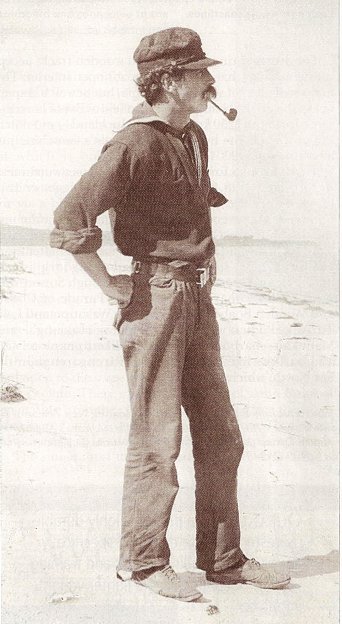
Learning the self-sufficiency of seamanship made one a better person, Day argued. At the same time, he embraced the romance of the sea – that something intangible about being on the open ocean enlivened the human spirit. In between writing how-to treatises on boat handling, he penned books of poetry about the sea. I’ve often imagined that he and Jimmy Buffett would have been fast friends had they lived at the same time.
Irene Agnes Returns
Discovering Tom Day shaped the direction of my academic career, but being back in school in the aftermath of the 2008 recession also left little time or money for Aggie. We eventually laid her up in 2011, imagining she’d be back in a couple years. However, life never goes quite the way you expect, and before we knew it, she’d been on the hard for more than a decade.
At one point, at the beginning of the pandemic,we put her up for sale and contemplated donating her somewhere. There was little interest though, and we were struggling to commit to the idea anyway.
Last year, we decided it was time to get back to sailing for fun again. Now living on Cape Cod, Laurie and I both still work in maritime-related professions but are not on the water ourselves as much for work anymore and desperately missed it. We knew no other boat would ever be as unique, interesting or fun to sail as our little Aggie, so she’s gone into the shop for a major restoration.
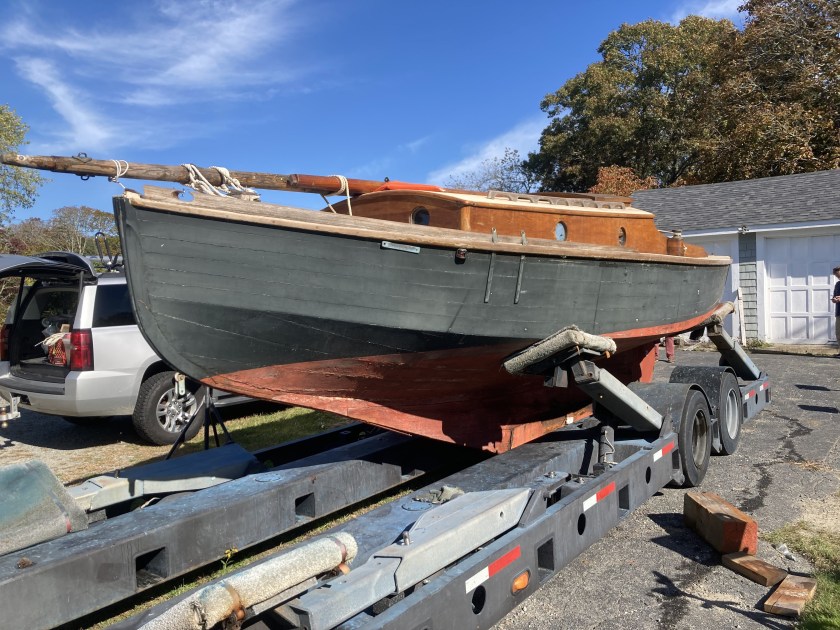
This time, we’re doing all the things we skipped over 20 years ago, as well as making up for a dozen years of largely deferred maintenance. With the incredible work of Dave Strecker and Keith Brown at Padanaram Boatworks in Portsmouth, Rhode Island, Aggie is getting set up for another 90 years of sailing adventures. She’s set to launch this spring (2025).
I’ve started this blog to share Aggie’s history and restoration, but also to uncover the stories of other Sea Birds as well as explore Thomas Fleming Day and the Sea Bird design itself. Reach out through our contact page if you’ve got a Sea Bird story or question.
Subscribe for notifications of future posts, uploaded resources and links to videos.
 The Sea Bird Yawl
Leave a comment