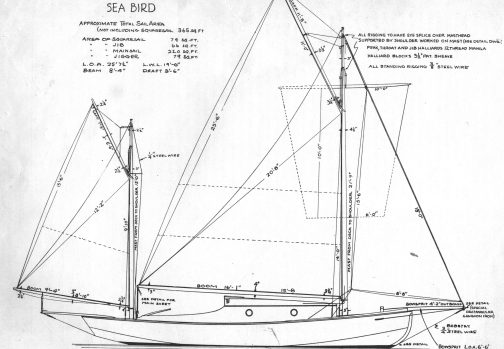
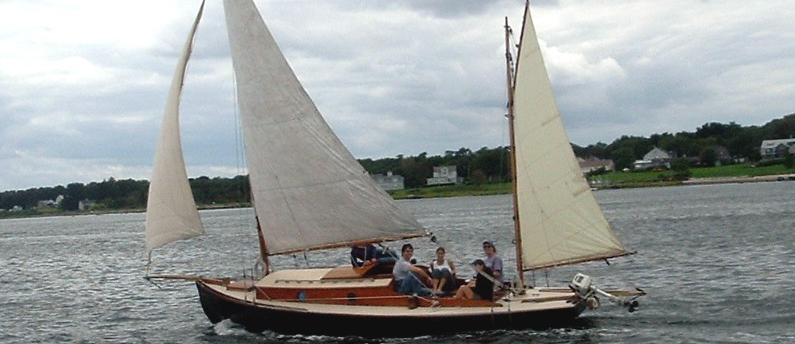
Note: This is the second post in a new blog about the restoration of our Sea Bird yawl Irene Agnes, and other stories of the Sea Bird design. You can find an intro post here.
When we decided last year to get Irene Agnes back underway, we already knew there were some substantial projects that would need to be completed. But as happens with wooden boats, as soon as you start taking it apart, you discover all sorts of other things that need to be repaired or replaced.
The worklist of repairs to Aggie’s hull has ballooned as a result. We had no choice but to pursue some of the fixes if we wanted a watertight boat. Others we debated over but chose to pursue to ensure that all the new work didn’t end up compromised by some weakness at the heart that we’d neglected. In some cases, it was simply cheaper to replace old parts than to work around them.
It’s all taking a lot longer to do and costing a lot more overall, but the net result is that Aggie is ending up in better shape than ever and ready to go sailing for the foreseeable future. Along the way, the process has also uncovered numerous mysteries about her history and original construction.
Finding Help
As a caveat to any would-be boatbuilders reading this, let me make clear that this is not a project we have done on our own. Laurie and I were keenly aware that we lacked the time, skills, and space to do this ourselves. Our goal was to get the boat back in the water, not spend the rest of our lives making a pastime of trying to restore it ourselves.
We needed professional help. Dave Strecker and Keith Brown, of Padanaram Boatworks in Portsmouth, Rhode Island, came recommended to us by Dave Peterson at Wooden Tangent in Mattapoisett, Massachusetts. When we had first bought the boat in 2004, Dave Peterson and Ben Carlson had replaced the horn timber, recanvased the housetop, and helped us with a number of smaller projects. Dave was closing his shop after retiring last year, but both Strecker and Brown had worked for him before starting their own shop. They had both also worked for Concordia in Padanaram, Massachusetts.
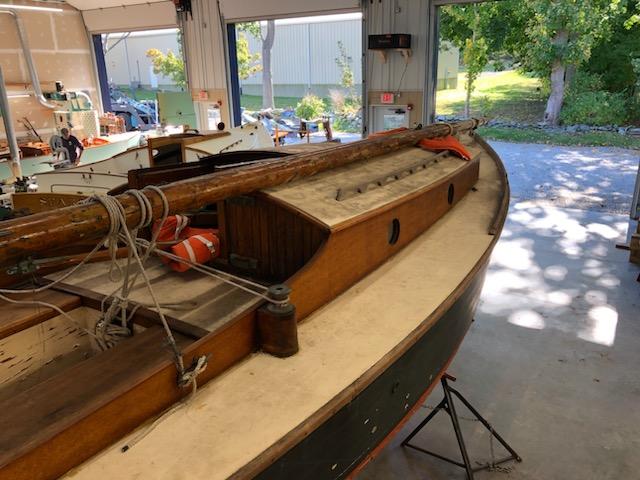
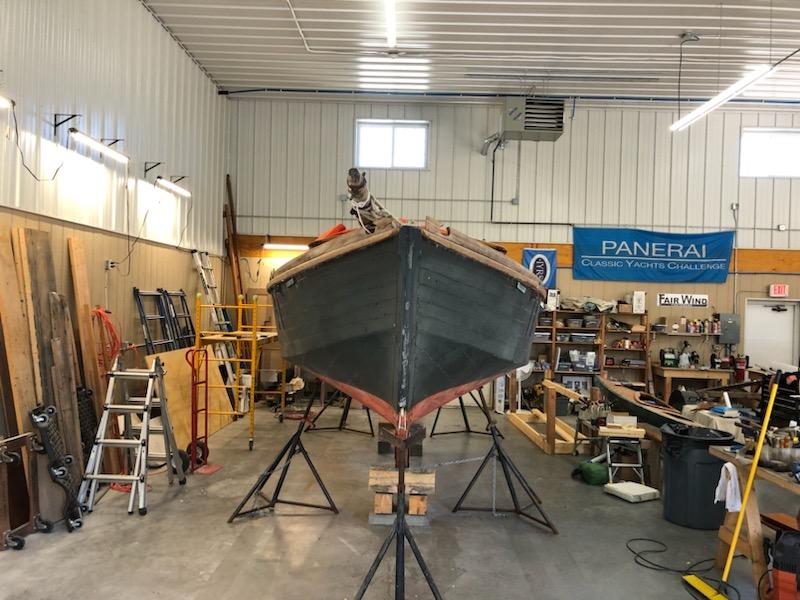
Keith and Dave have been awesome. Diving into all the frustrating idiosyncrasies of what was originally an amateur-built boat, they’ve still managed to develop a passion for the Sea Bird design. They’re making Irene Agnes as strong as possible, while remaining very cost-conscious at every step along the way.
We’ll have more detailed blog posts on specific projects, but for now, here’s an overview of the major work being done.
The Rudder
At the top of the list when we first contemplated relaunching Aggie was replacing the rudder. This was a project we had considered taking on in 2004 when we first acquired the boat but decided to put off at the time. It was no longer optional.
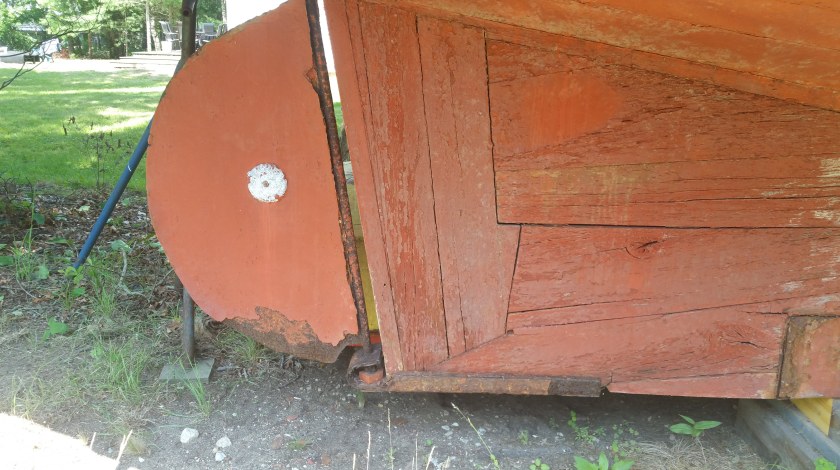
Aggie’s rudder was a simple slab of sheet metal cut to shape and welded to a shaft, but it and the heel shoe holding it to the keel had completely rusted out. Ironically, considering it was the first thing we knew we had to address, it has become just about the last thing to get done, as other work has occurred around it. The new rudder will have a bronze pintle and gudgeon with a shaft passing through a stuffing box in the bottom of the hull.
The Chine
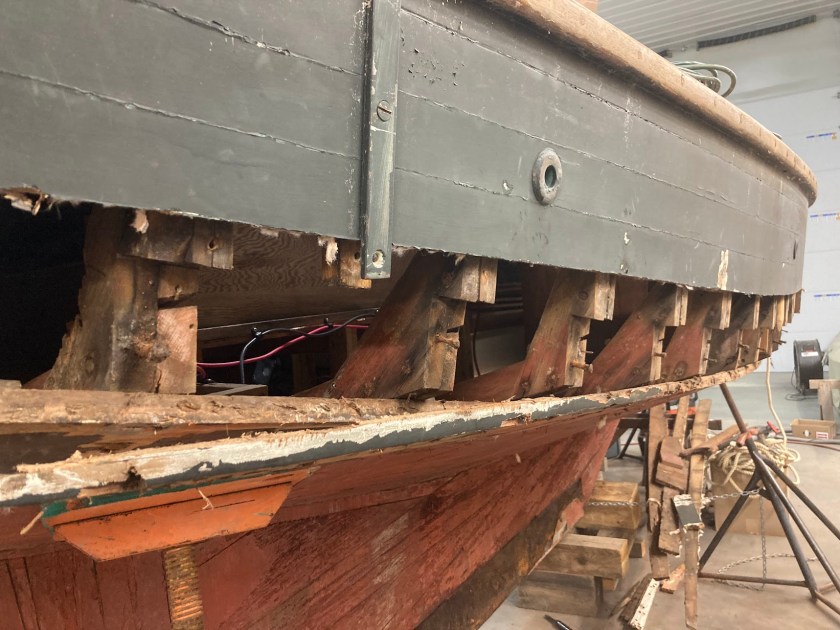
We knew the chine logs would eventually need to be refastened and possibly replaced. Pulling the planks uncovered the extent of the decay. The chine was one of the primary places with original steel fasteners, many of which were nearly gone. The chine itself and the gussets holding it to the frames were a mess. Both chines are being replaced with all new gussets as well as the planking over it.
Stem and Stern
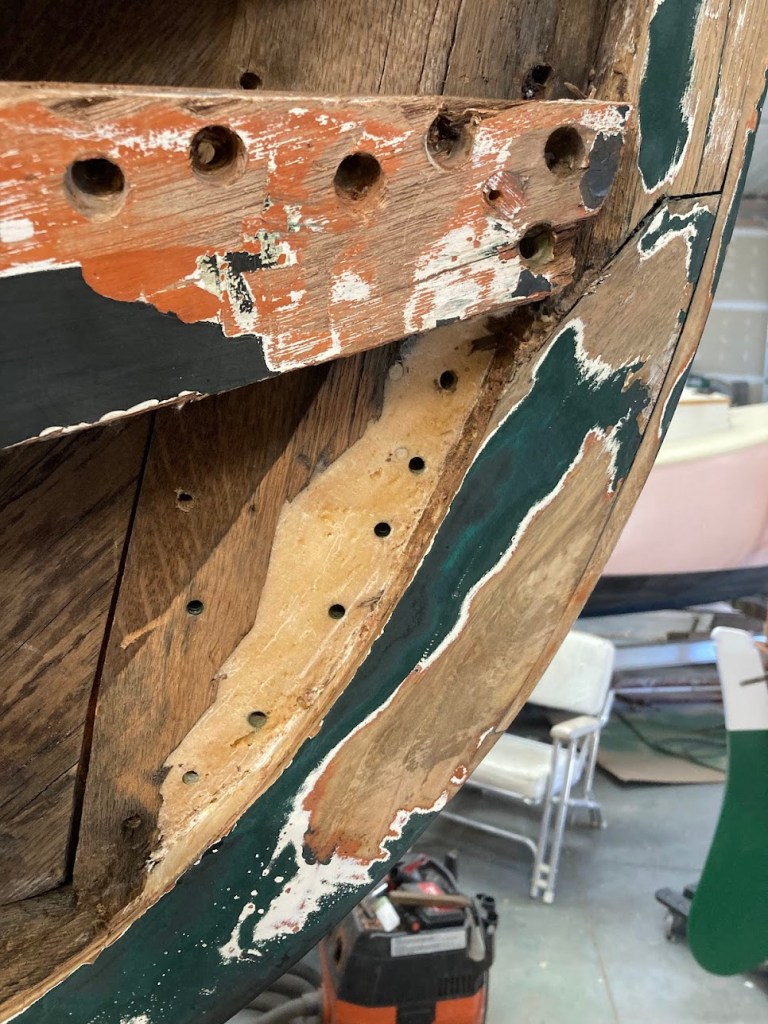
As planks were sprung at either end to access the chine log, issues became apparent with the stem and the transom where the planks were fastened. Numerous refastenings over 90 years had left too many holes to count, and rusting steel fasteners had rotted out the wood they were driven into. The issues might have still been repairable had spaces at both ends not been filled with resin and 5200 at various points in the past, leaving both ends either too brittle or too stuck to fix in place. The net result for Aggie is a new stem and transom.
Keel and Deadwood
Going into the project, we knew there were keelbolts that might warrant replacement. In addition, the iron ballast block at the bottom of the keel was rusting similar to the rudder and shrinking in size as a result. All of this was going to mean doing repair work to the deadwood under the keel, but the plan changed when Dave lofted a new rudder from the plans and discovered that it was 5 inches deeper than the keel. Turns out Aggie had been built with a shallower keel than the plans called for – something I had long suspected but never confirmed.
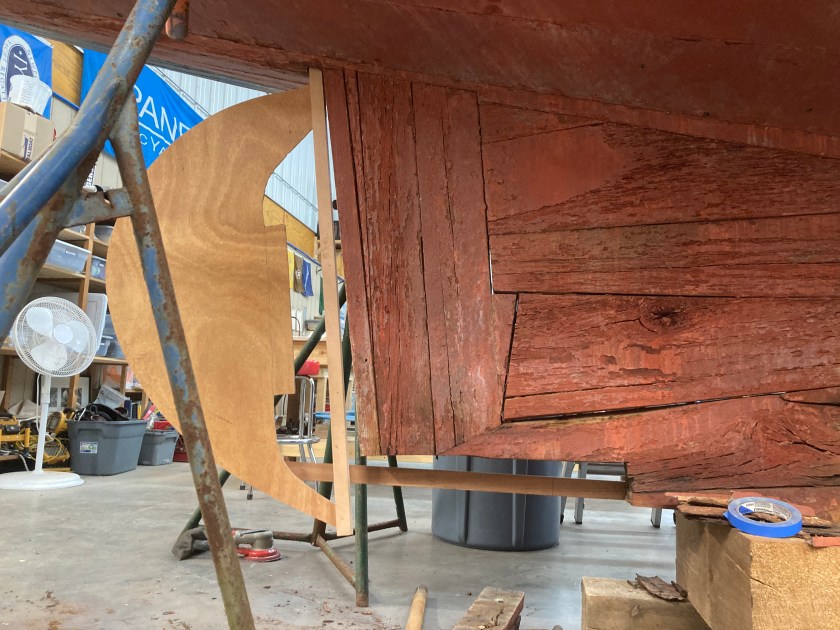
Combined with the prospect of rot in some of the original deadwood pieces, we decided to replace the whole thing. A new single piece of white oak deadwood and a new lead cast external ballast block will all match the original design specs for the boat. Doing so has also meant that the very last of any old steel in the boat will be removed and replaced with bronze, ensuring a longer life here out.
Stay tuned for future posts detailing each of these projects, and other improvements we’re making. We’ll also have stories about Aggie’s history and the adventures of other Sea Birds over the last century.
Subscribe to get future posts notifications by email.
 The Sea Bird Yawl
Leave a comment